Edge Scientific

Menu
  • About Edge
    • Opportunities
    • News & Events
  • Products
  • Web Store
  • Partners
  • Contact
  • Diatome Knives

QM Quantum microscope – next generation imaging & analysis

August 9, 2019 by

Non-destructive. No sample prep. Completing your correlative suite.

KMLabs QM Quantum MicroscopeTM advanced photon imaging solution is a fully integrated, commercialized platform enabling ultrafast spectroscopy in the EUV range and high-contrast, near surface-to-subsurface imaging at the nanoscale. It enables laboratory-based 2D high contrast imaging of composition and structure, study of mechanical properties of patterned films, deep understanding of materials properties, and functional characterization of spintronic, ALD, 2D, low-density lightweight, energy, space and photovoltaic materials.

A suite of integrated systems developed to elucidate critical details of critical technology problems.

By combining the time sensitivity of femtosecond lasers with the spatial resolution of EUV microscopy and diffraction, QM enables a series of techniques tuned for important challenges in research and industry. E.g., for batteries, EUV absorption near the lithium edge provides a microscopic and spectroscopically rich area to understand lithium bonding. For semiconductors, QM provides critical detail on buried and surface nanotopography with unique sensitivity to bonding.

Completely configurable, the QM Quantum Microscope comprises a laser source (EUV and/or VUV), amplifier, beamline tailored to the user’s experiment, and imaging or other analysis workstations that can effectively cover the microscopy/spectroscopy landscape for nano-to-quantum materials.
For more information…

XUUS – high harmonic generation source for EUV and soft X-ray

August 9, 2019 by

From the pioneer in robust, engineered EUV systems

Good news: you no longer have to dedicate your laboratory resources to building a high harmonic generation (HHG) system. The 4th generation of KMLabs’ XUUS™ extreme UV ultrafast source is a turnkey system that gets you right into your experiment. XUUS4 is a coherent EUV/soft X-ray light source based on high harmonic generation. It is a fully-engineered and integrated commercial source based on a single robust opto-mechanical platform.

XUUS4 upconverts ultrafast laser pulses into the Extreme UV (EUV or XUV) or soft X-ray regions of the spectrum. Employing HHG processes, the output beam inherits the coherent properties of a driving laser such as the KMLabs RAEA with wavelengths that can be tuned from ~10 to 47 nm. Moreover, customized systems can generate coherent beams with wavelengths as short as 6.5 nm. XUUS4 employs KMLabs’ patented hollow waveguide for the high harmonic up-conversion process.

The XUUS hollow-core fiber, or waveguide, architecture enables harmonics generated by the system to be distinguished from other HHG methods, guaranteeing your harmonics originate from the same point in space every time, minimizing any pointing drift. This optimizes repeatability for your experiments. Additionally, the use of a fiber rather than typical gas jet or semi-infinite gas cell target geometries provides superior pressure tunability for phase-matched HHG. Now you can choose robustness without sacrificing flexibility.

For more information…

RAEA Next-Generation Ultrafast Ti:sapphire Amplifier

August 9, 2019 by

RAEA™ Ti:sapphire amplifier builds on KMLabs’ 20-year tradition of leadership in ultrafast science, bringing the unmatched flexibility of previous amplifier systems into a single, hands-free platform. 

Unprecedented reliability

RAEA has been engineered to make system operation as simple as possible. With temperature-controlled modules, contamination-minimizing enclosures, and remote alignment capability, maintaining your RAEA system is easier than ever. We have designed every aspect of this system to ensure that you spend more time on your experiments and less time working on your laser.

For more information…

Chromatis – Dispersion Measurement

August 9, 2019 by

Chromatis™ production-grade test instrument is designed specifically to measure group delay dispersion in optical components for femtosecond applications.  It is a broadband optical test instrument that quickly and accurately characterizes the full dispersive properties of optical components and coatings.  Carefully managing optical dispersion is critical for optimal performance of ultrafast laser systems, multi-layer mirrors, and multiple quantum well structures.  Chromatis is user friendly, self-calibrating, and highly accurate.

For more information…

Halcyon – Ti:Sapphire Oscillator

August 9, 2019 by

The KMLabs Halcyon™ repetition-rate stabilized oscillator is popular with customers who need to synchronize oscillator laser pulses with pulses from another laser or with a synchrotron.  Electronics included with the Halcyon lock its output to the customer’s reference signal and can provide timing jitter of less than 150 fs.  Stabilization of the repetition rate is achieved through multiple features including a temperature-stabilized breadboard, a motorized stage for coarse feedback, and a small piezo-mounted mirror for fast feedback.  The KMLabs team works closely with each Halcyon customer to ensure that the system meets their specific needs.  Due to the flexible design of the Halcyon™, it can lock to reference signals over a very wide range:  75 MHz to 4 GHz.

For more information…

Griffin – Ti:sapphire Oscillator Family

August 9, 2019 by

The KMLabs Griffin™ series of Ti:sapphire oscillators gives customers ultimate control over their system, are simple to maintain, and offer a wide range of performance specifications enabling many different applications.  These prism-based oscillators use Kerr lens modelocking to generate ultrashort < 12 fs pulses.  All Griffin lasers include computerized control of the spectral bandwidth and center wavelength and water-cooled breadboards for maximum long term stability. There are options within the Griffin series that include integrated pump lasers and diagnostics. Griffin lasers are very simple to maintain, since components are easily accessible.

For more information…

Y-Fi HP

August 9, 2019 by

The KMLabs Y-Fi™ laser series is a family of compact high average power, high repetition rate near-IR ultrafast Yb fiber lasers. Y-Fi products are based on a single rugged opto-mechanical platform and are engineered for hands-free operation.

For more information…

Y-Fi NOPA

August 9, 2019 by

Y-Fi™ NOPA is KMLabs’ compact laser for 2-photon microscopy as well as a variety of other applications in imaging and spectroscopy. Y-Fi NOPA  is pumped by Y-Fi HP, whose class-leading pulse duration results in reliable high peak and average power from the Y-Fi NOPA, allowing for versatility in obtaining optimal image quality and depth. The 1035 nm output from Y-Fi HP is also available for imaging and optogenetics applications.

For more information…

Y-Fi OPA

August 9, 2019 by

Y-Fi™ OPA is KMLabs’ vertically integrated, collinear optical parametric amplifier pumped by a Y-Fi HP. The class leading pulse duration of the 1035 nm centered Y-Fi HP results in both a stable, coherent white light seed source and an exceptionally high conversion efficiency into the short-wave (1250-1800 nm) and mid-wave (2.4 – 4.4 μm) infrared.

For more information…

Y-Fi VUV – vacuum ultraviolet source

August 9, 2019 by

Probe material and molecular properties with unprecedented flexibility on ultrafast time scales

KMLabs Y-Fi™ VUV provides bright femtosecond pulses at numerous wavelengths across the vacuum ultraviolet (VUV) region, from 6.0 eV (205 nm) to 10.8 eV (115 nm). The discrete tunability of the KMLabs Y-Fi VUV vacuum ultraviolet source enables researchers to study a wide range of materials and materials properties. A simple computer-selected change of photon energy provides a powerful capability, previously only available at a synchrotron; this ability to easily change the laser wavelength can enhance many experiments. For example, in angle-resolved photoemission (ARPES) experiments, this tunability allows researchers to distinguish surface effects from bulk effects. For time-of-flight (ToF) studies of molecules, the tunability can distinguish otherwise identical isomers.

For more information…

NanoLIMS

August 25, 2017 by

Laboratory Information Management System

Overview

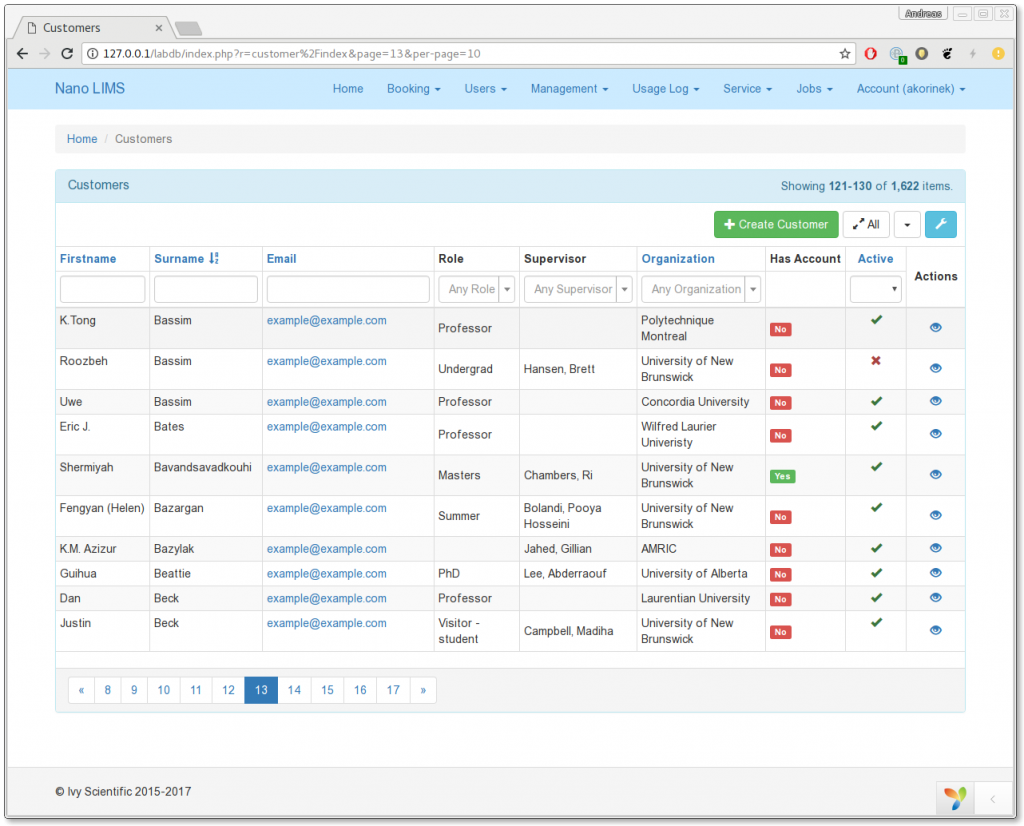
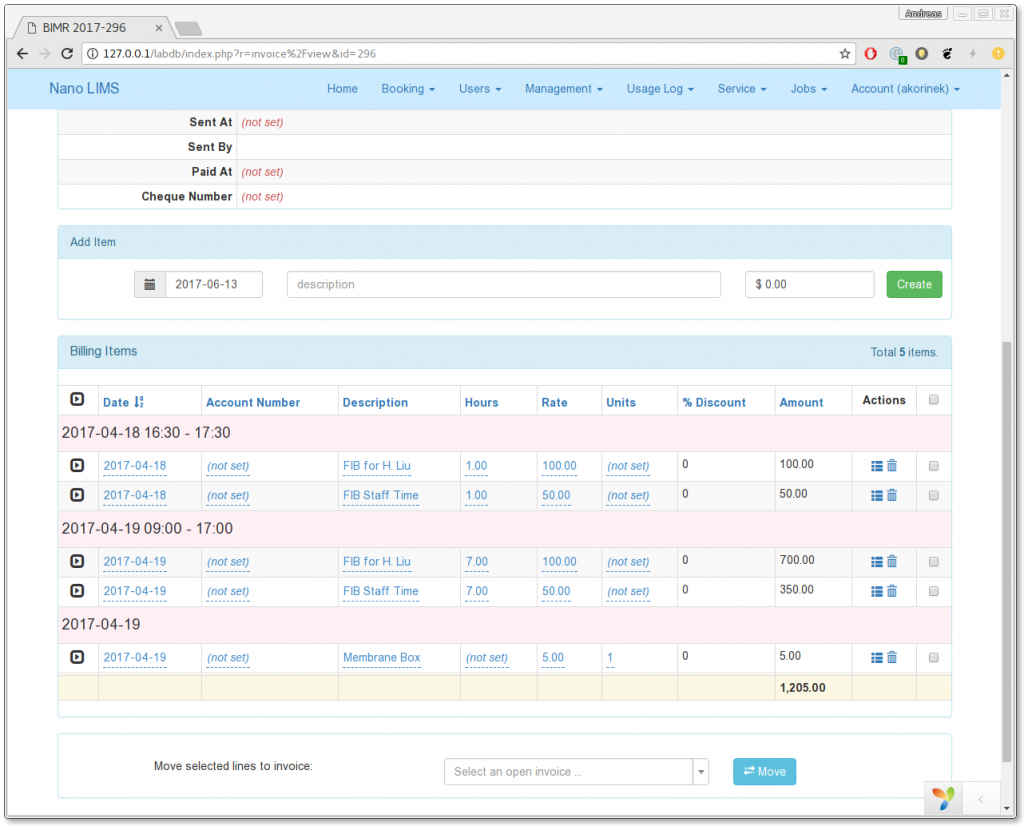
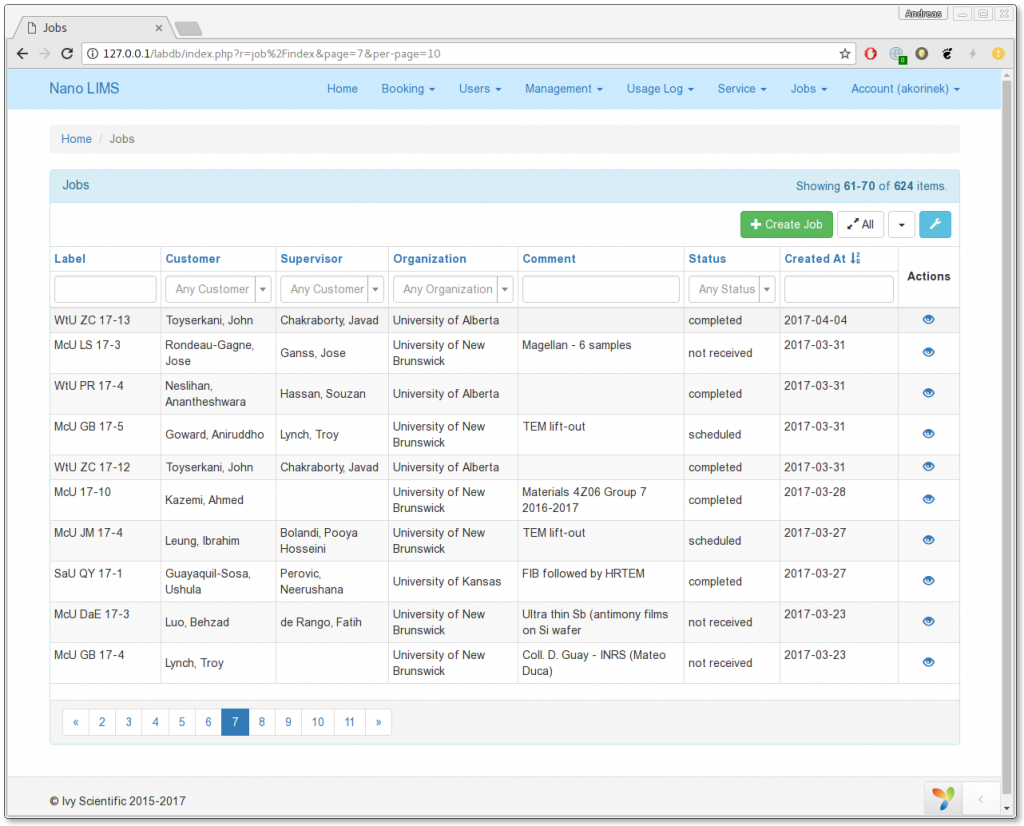
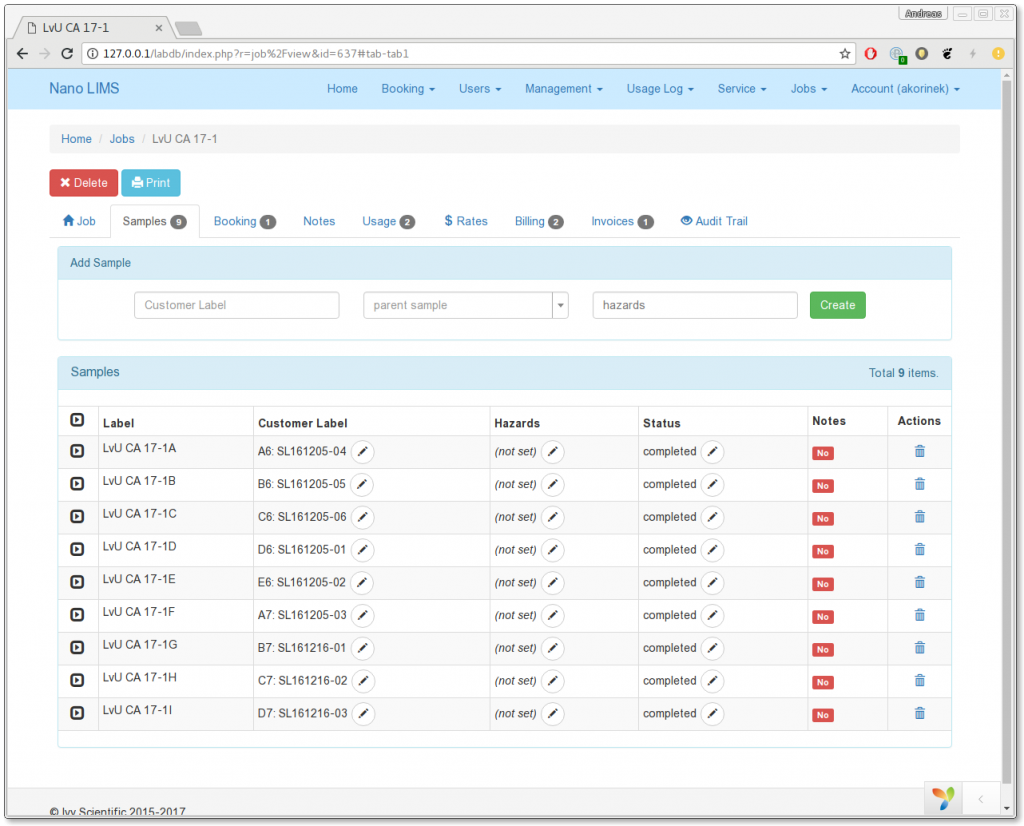
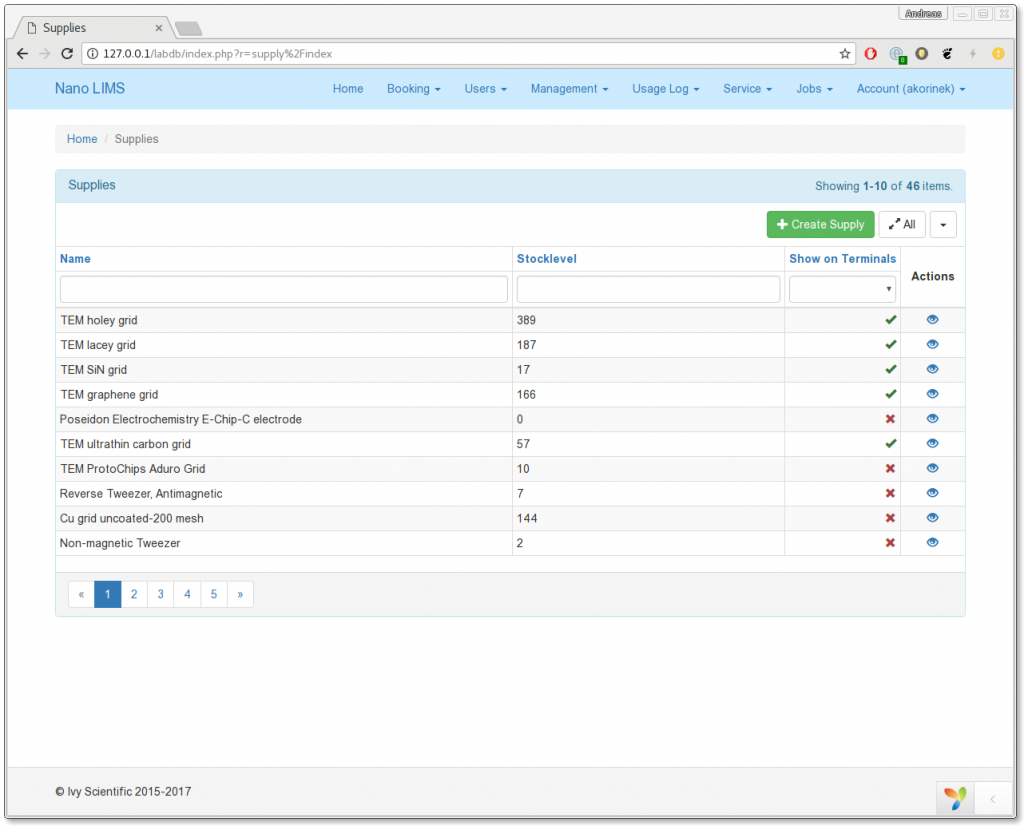
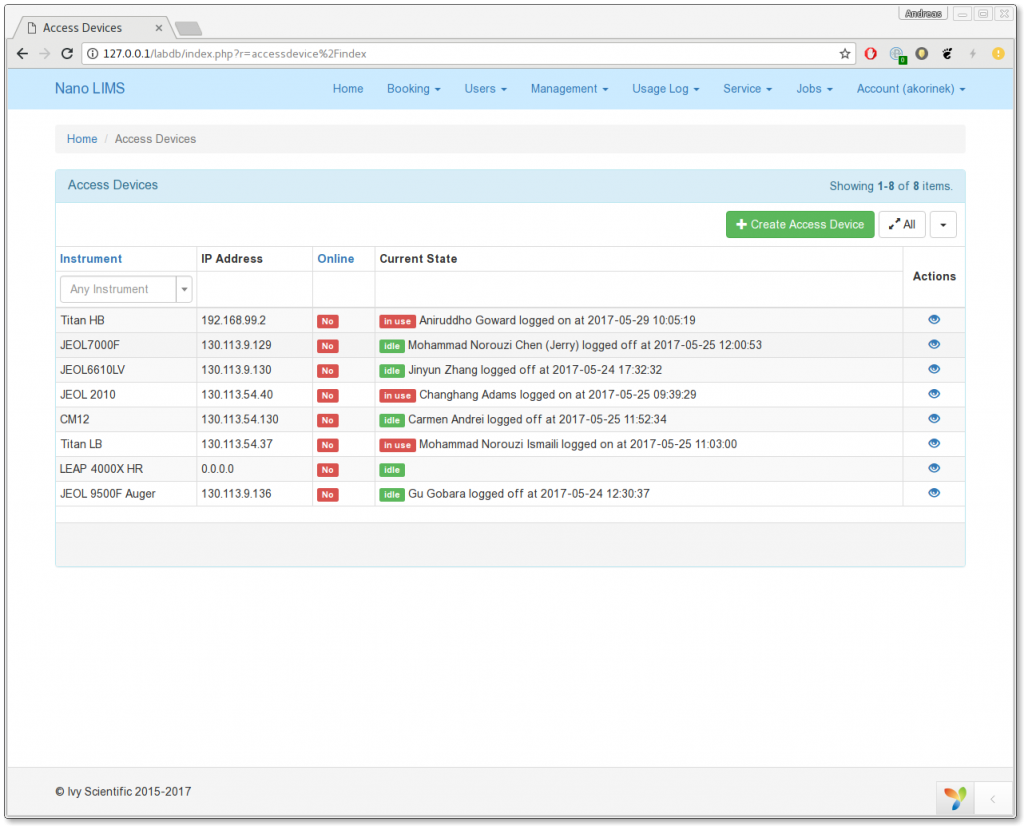
NanoLIMS provides a customizable environment to manage all aspects of a laboratory facility. The goal is to model all relevant types of data that need to be documented and save / present them in a transparent and standardized way. Using proven technologies such as a relational database as a backend and a web-based frontend, data integrity and compliance with regulatory standards are ensured.

Features

  • Includes all necessary hardware devices to control instrument access
  • Customers (students, professors, industry customers)
  • Jobs and related samples including staff notes and emails
  • Result data storage under strict permission management
  • Instruments (microscopes)
  • Instrument users
  • Instrument user training status and permissions
  • Time Management (bookings and staff time)
  • Supplies and Consumables
  • Service Logs
  • Instrument service tickets
  • Billing and Invoicing
  • Report generation
  • Role Based Access Control

Licensing

NanoLIMS offers flexible licensing options including:

  • Full support and training for staff
  • Bug fixes
  • New features and code maintenance
  • Custom features are either included in cost of license or are priced individually depending on required code changes
  • Hardware maintenance and backup of all data

Screenshots


Lyncean Compact Light Source (CLS)

August 25, 2017 by

* Lyncean products are no longer available.

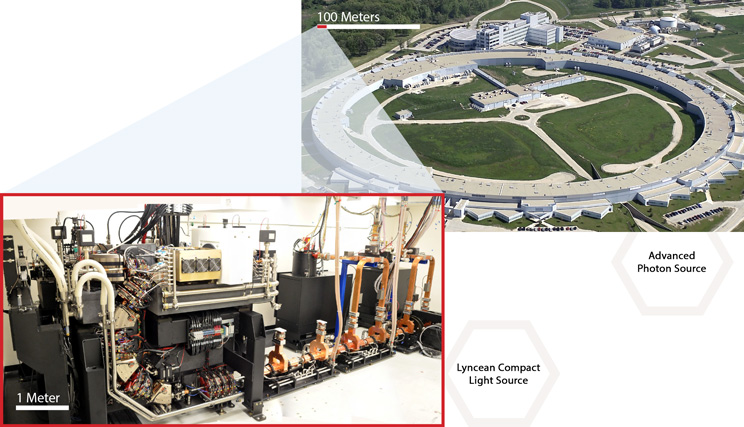
The Lyncean Compact Light Source (CLS) is a breakthrough technology that addresses the increasing demand for access to high quality X-rays by offering the possibility of a synchrotron beamline for home laboratory applications. The Lyncean CLS X-ray beam shares some favorable features of synchrotron light – a continuously tunable energy spectrum and high spatial coherence – combined with some unique attributes such as intrinsically narrow bandwidth (few %) and a moderate (few milliradian) diverging cone beam. The highly peaked spectrum provides an extremely low-noise background compared to both conventional sources and many synchrotron beamlines.

The cone beam divergence is small enough to be efficiently focused with x-ray optics yet large enough to provide a nearly uniform area beam by letting the native beam drift several meters. The Lyncean CLS X-rays provide powerful probes to reveal a range of physical structure down to the atomic scale. The Lyncean CLS is useful across many disciplines of X-ray science, including materials, nanotechnology, structural biology, medical sciences, semiconductor metrology, pharmaceutical development, and other chemical and physical sciences. The Lyncean CLS provides scientists with access to local, on-demand synchrotron light, allowing for an unprecedented new level of productivity.

The Lyncean CLS miniature synchrotron source allows for energy and scale reduction by a factor of 200

The Lyncean CLS development builds on the U.S. investment in large synchrotrons, but with a new technology that allows the source to be very compact. Conventional synchrotron light sources employ multi-GeV electron beams that are stored in large rings of magnets to generate intense, bright, 1 Å wavelength radiation. The Lyncean CLS employs an electron beam and a high power “laser undulator” to accomplish the same effect. The shift from cm scale periodic magnets used in a typical synchrotron light source, to sub-micron period laser pulse used in the Lyncean CLS, allows a reduction of energy and scale by a factor 200 – a stadium size machine becomes a room size machine!

Enabling the future of laboratory X-ray experimentation

X-ray scientists at synchrotron laboratories around the world have developed a vast array of applications over several decades, many of which cannot be exploited using conventional sources, but can be performed by the Lyncean CLS. By opening access to these powerful x-ray applications, the Lyncean CLS enables new avenues of discovery to a broad range of researchers.


Software

September 1, 2016 by

To be truly effective and easy-to-use, the best instrumentation requires powerful and intuitive software for data acquisition and image processing. Besides our continual push for innovation in TEM hardware, Direct Electron also invests heavily in developing and improving software tools related to TEM imaging. Our philosophy is to deliver the latest software tools with as much flexibility as possible so you can acquire and process your data as needed to accomplish your scientific goals.

For more information…

LV-Series

September 1, 2016 by

Our LV-Series Cameras bring the power of direct detection to low-voltage TEM applications, such as LEEM/PEEM. These cameras are a dramatic improvement over traditional detectors such as channel plates + CCD.

For more information…

FC- Series

September 1, 2016 by

Founded upon more than two decades of experience with scientific CCDs, our fiber-coupled CCD cameras provide uncommonly high quality TEM imaging at a low cost. FC-series cameras are ideal for common TEM applications such as specimen screening, tomography, pathology, negative stain, etc. Additionally, the inherently high dynamic range of these sensors make them a great choice for diffraction, spectroscopy, and other high-intensity applications.

For more information…

  • « Previous Page
  • 1
  • …
  • 3
  • 4
  • 5
  • 6
  • 7
  • Next Page »
    • About Edge
    • Partners
    • Contact
  • My Account
  • View Cart
  • Request Quote

Search for…

×

Product Categories

  • AFM / SPM
  • Calibration
  • FIB Supplies
  • Instruments
  • LM
  • Sample Preparation
  • SEM Supplies
  • TEM Supplies
  • Uncategorized
  • Vacuum Supplies

Join our mailing list to receive special promotions from Edge Scientific.

Follow us on Twitter

Edge Scientific

Edge Scientific provides researchers and facilities with the expertise and equipment to customize their systems by integrating product lines for nanotechnology applications. Our approach is comprehensive. We assess the needs of our customers to develop complete application solutions for proposal submissions. We also employ application specialists with the expertise to ensure optimization of the systems we support.

Edge Scientific – Leading nanotechnology solutions.

Headquarters

1431 Merivale Road
Lower Level Suite 200
Ottawa, Ontario, CA
K2E 0B9
e. stephenwood@edgescientific.com
p. 1 855 832-9360

Edge Scientific EM Consumables Store Visit the Webstore

Copyright © 2026 Edge Scientific. All Rights Reserved. Maintained by Sociation